Objective: To utilize one-way hashing algorithms to verify data authenticity and secure credential storage.
1. The Vulnerability: Data Tampering & Plaintext Credentials
If data is stored or transmitted without integrity checks, it can be altered undetected, leading to a loss of Authenticity. Additionally, storing user passwords in plaintext exposes the organization to catastrophic identity theft in the event of a database breach.
2. Technical Execution: Hash Function Deployment
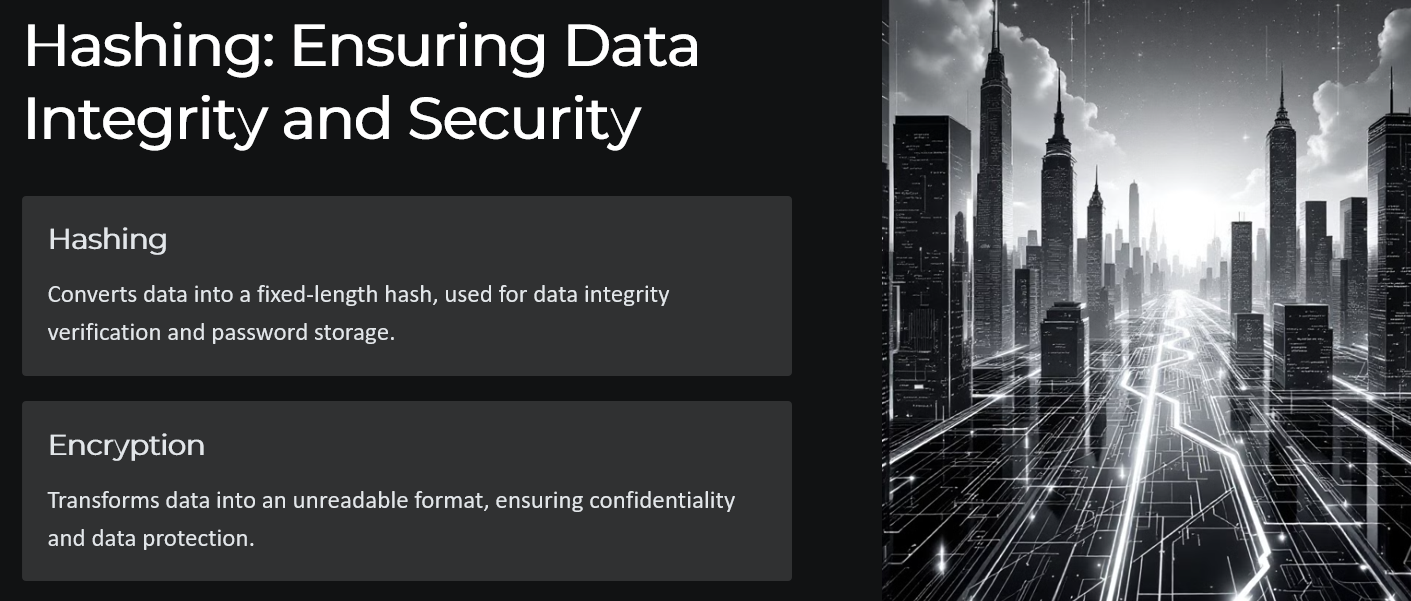
I implemented cryptographic hashing to convert variable-length data into fixed-length “fingerprints.” Unlike encryption, these functions are one-way, making them ideal for verifying that files have not been modified and for securely storing password hashes rather than original values.
| Component | Value | Purpose |
|---|---|---|
| Hash Function | SHA-256 / MD5 | Generates a unique, fixed-length string from data. |
| Integrity Check | Checksum Verification | Detects if data was altered during storage or transit. |
| Auth Security | Password Hashing | Prevents original passwords from being recovered from a DB. |
3. Execution Workflow
- Integrity Baselining: Generated initial hashes for critical system configuration files to serve as an “unaltered” reference.
- Detection Logic: Automated a periodic comparison of current file hashes against the baseline to detect unauthorized changes.
- Secure Storage: Configured the application backend to hash user passwords immediately upon registration.
- Verification: Implemented login logic that hashes the user’s attempt and compares it to the stored hash, ensuring Authentication without exposing the secret.
4. Key Commands
# Example: Generating a SHA-256 hash to verify a file's integrity
sha256sum sensitive_data.zip

# Example: Verifying hashes against a recorded list
sha256sum -c integrity_manifest.txt
5. Evidence of Work
6. Professional Impact
This project ensures Data Integrity, confirming that information remains unaltered without detection. By implementing hashing for password storage, I significantly mitigated the risk of a secondary credential breach, preserving Authentication protocols even if the underlying data store is compromised.