Objective: To identify and verify directory traversal vulnerabilities that allow unauthorized access to sensitive system files.
1. The Vulnerability: Path Traversal (CWE-22)
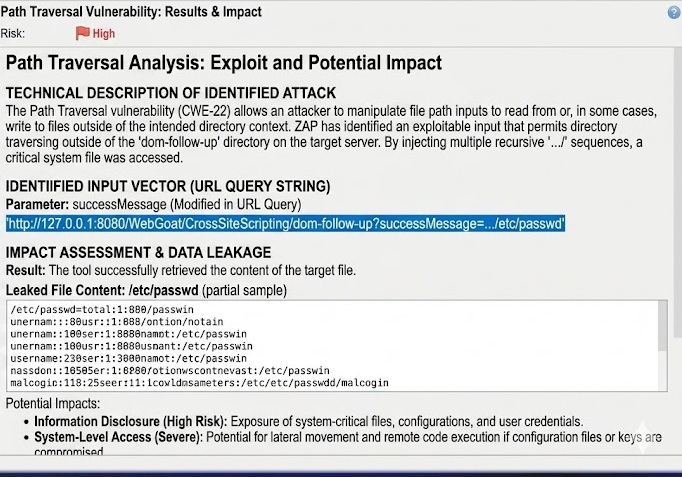
The web application was found to be vulnerable to Path Traversal (also known as Directory Traversal) because it failed to properly sanitize user-supplied input used to reference files on the server. This flaw allows an attacker to use special characters, such as ../, to break out of the intended web root directory and access restricted files or directories elsewhere on the file system.
2. Technical Execution: Resource Interrogation
I utilized OWASP ZAP to identify parameters susceptible to path manipulation. By injecting traversal sequences into the column parameter of the target URL, I observed the application’s response to determine if it would disclose file paths or system-level error messages.
| Component | Value | Purpose |
|---|---|---|
| Vulnerable Parameter | column | The input vector used for path manipulation. |
| Risk Level | High | Potential for full system file disclosure. |
| Detection Method | Active Scanning | Automated probing of parameters for traversal flaws. |
| Tool | OWASP ZAP | Facilitates the identification of insecure file referencing. |
3. Execution Workflow
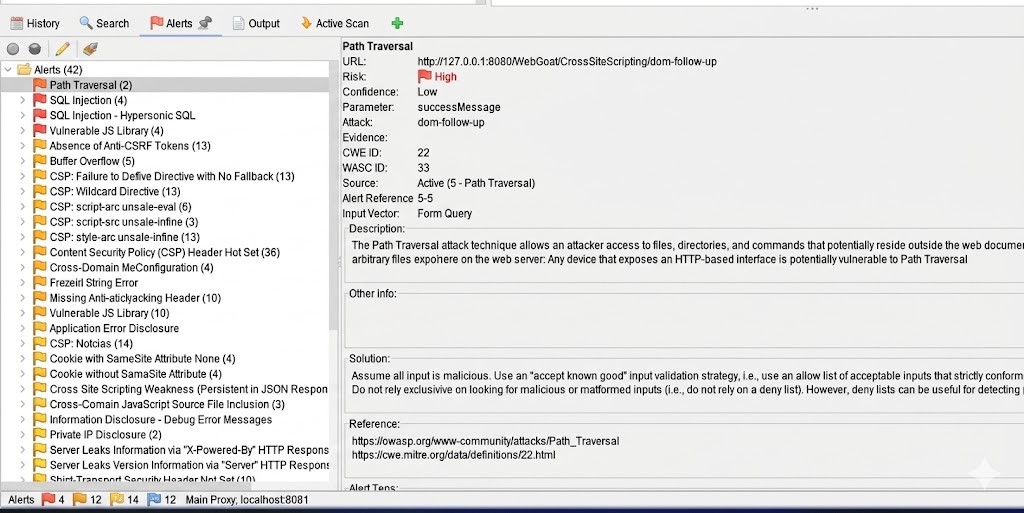
- Automated Reconnaissance: Initiated an Active Scan within OWASP ZAP to systematically test the application’s URL parameters for traversal vulnerabilities.
- Alert Analysis: Flagged a “Path Traversal” alert which indicated that the application was improperly handling input in the
columnparameter. - Payload Verification: Analyzed the attack vector to confirm that the technique could potentially reach directories residing outside the web primary folder.
- Context Evaluation: Noted the request URLs and parameters where the vulnerabilities were flagged to determine the scope of the exposure.
4. Key Commands
# Example of a traversal payload identified during the scan
# This attempts to move up the directory tree to reach system files
../../../../etc/passwd

# The targeted URL identified by ZAP
http://localhost:8080/WebGoat/SqlInjectionMitigations/servers?column=..%2F..%2F
5. Evidence of Work
6. Professional Impact
This project highlights a critical risk to Data Confidentiality and System Integrity, as an attacker could potentially read sensitive configuration files or credentials stored on the server. To remediate this, I recommended that the application validate user input against a known “allow-list” of expected values rather than relying on sanitizing malicious sequences. Furthermore, I advised ensuring that the application process runs with the least privilege necessary to prevent access to sensitive operating system files.