Objective: To establish a behavioral baseline for legitimate network traffic and use protocol analysis to isolate potential security threats.
1. The Vulnerability: Obfuscated Network Activity (CWE-1021)
A significant vulnerability in modern networks is the inability to distinguish between legitimate background services and malicious traffic. Attackers often use Domain Spoofing and typosquatting (e.g., googleagmanger.com instead of googlemanager.com) to hide their presence. Without a documented baseline of normal traffic, these subtle anomalies often go unnoticed, allowing malware to maintain persistence and communicate with external servers.
2. Technical Execution: Protocol Interrogation
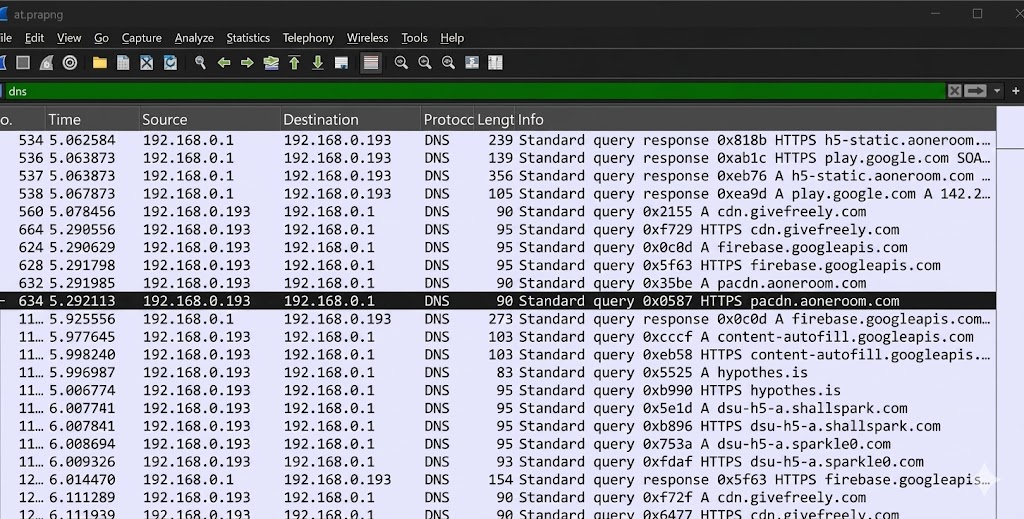
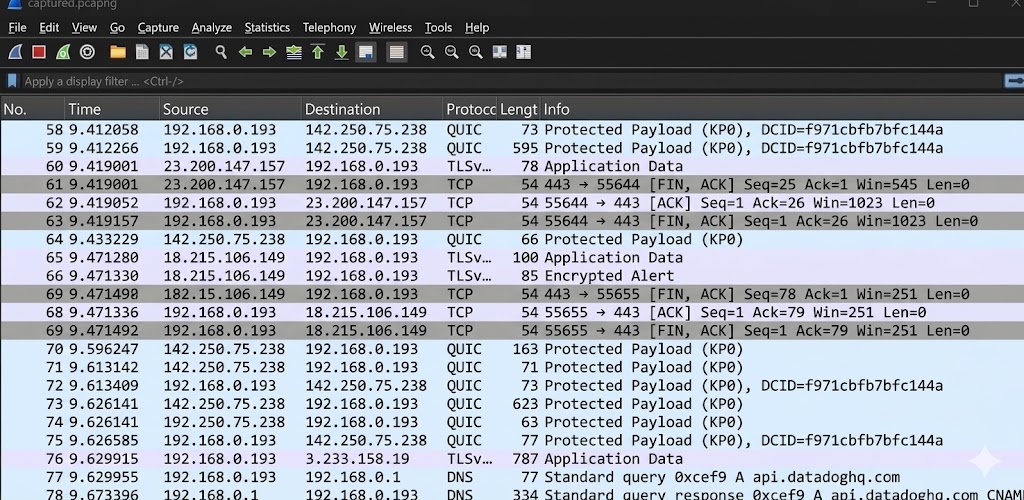
I conducted a deep-packet analysis using Wireshark to categorize traffic by protocol and destination. By filtering for DNS and HTTPS traffic, I was able to verify the legitimacy of routine queries to known services like Google and Firebase while flagging high-frequency queries to unfamiliar domains.
| Component | Value | Purpose |
|---|---|---|
| Analysis Tool | Wireshark | Real-time packet capture and deep-packet inspection. |
| Baseline Protocol | TLSv1.2 / QUIC | Verified encrypted web communication for trusted services. |
| Anomaly Vector | DNS CNAME Chaining | Identified rotating IP patterns used to evade detection. |
| Environment | Personal/Home Network | Testing site for live monitoring and traffic differentiation. |
3. Execution Workflow
- Traffic Capture: Initiated a live capture session in Wireshark to monitor all inbound and outbound system traffic.
- Behavioral Baselining: Identified and documented safe traffic patterns from reputable services like Grammarly and Google.
- Anomaly Identification: Filtered for DNS queries and identified a cluster of domains (e.g.,
trasre.com) that exhibited suspicious behavior, such as resolving through multiple IP addresses via Cloudfront and Aliyun CDNs. - Impact Verification: Determined that the identified domains were typical of rotating Command-and-Control (C2) infrastructure used for malware distribution.
4. Key Commands
# Filter Wireshark traffic to show only DNS queries
dns

# Filter to identify specific suspicious domain resolutions
dns.qry.name contains "aoneroom"

# Analyze TLS handshakes for version verification
tls.handshake.version == 0x0303
5. Evidence of Work
6. Professional Impact
This project directly addresses System Integrity by establishing the “Known Good” state of a network. By developing the ability to recognize abnormal DNS patterns and C2 communication, I provided a proactive defense that identifies compromises before data exfiltration occurs. This work demonstrates the practical value of traffic monitoring in detecting early indicators of compromise and informing a multi-layered remediation strategy.