Objective: To enforce strict security policies at the kernel level, preventing unauthorized resource access by compromised services.
1. The Vulnerability: Excessive Privilege & Service Exploitation
Traditional Linux permissions (Discretionary Access Control) are often insufficient if a root-level service is compromised. Without Mandatory Access Control, a compromised web server could potentially access sensitive user home directories or system configuration files.
2. Technical Execution: SELinux Policy Enforcement
I deployed Security-Enhanced Linux (SELinux) to enforce granular security policies on the host system. By managing SELinux modes and rules, I ensured that even “root” users or services were restricted to the minimum resources required for their specific function.
| Component | Value | Purpose |
|---|---|---|
| SELinux Mode | Enforcing | Actively blocks and logs all policy violations. |
| Policy Type | Targeted | Restricts specific network services while allowing normal user activity. |
| Diagnostic Tool | audit2allow | Analyzes logs to resolve policy-based service issues. |
3. Execution Workflow
- Mode Verification: Evaluated current system posture using
getenforceand transitioned the system to Enforcing mode. - Policy Configuration: Applied specific rules to allow web services (e.g., Apache/Nginx) to access only designated web root folders.
- Violation Analysis: Monitored system logs to identify blocked actions that indicated either an attack or a misconfigured policy.
- Remediation: Utilized diagnostic tools to generate and apply custom policy modules to allow legitimate service operations.
4. Key Commands
# Example: Checking the current SELinux enforcement status
sestatus

# Example: Troubleshooting a blocked service by searching the audit log
grep "denied" /var/log/audit/audit.log | audit2allow -M my_service_fix
5. Evidence of Work
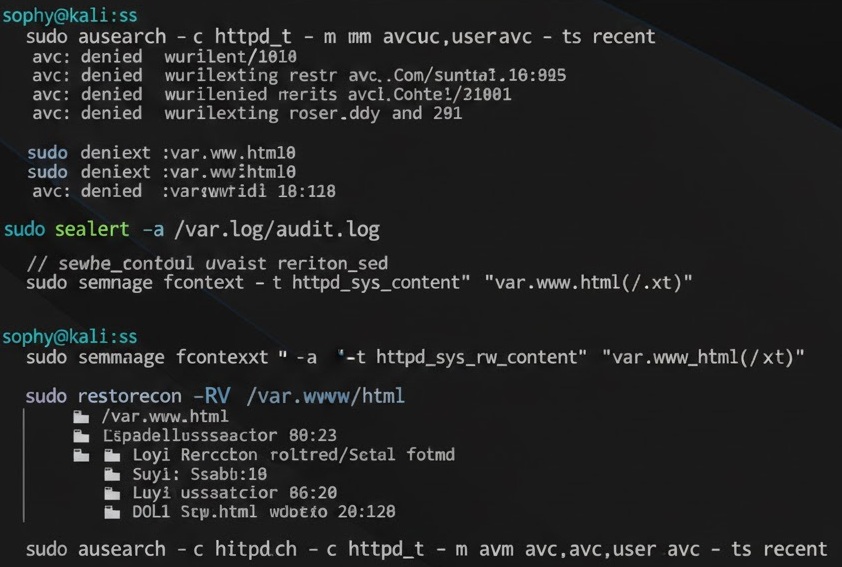
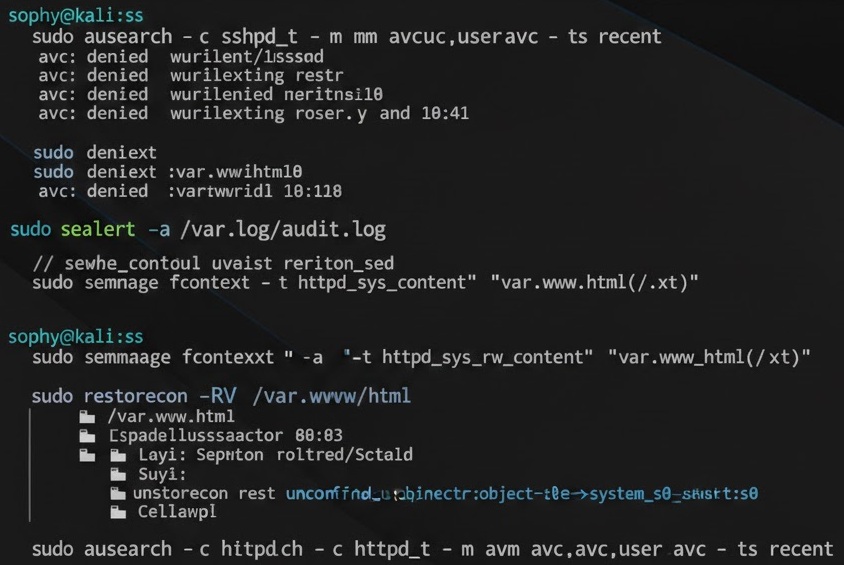
6. Professional Impact
Implementing SELinux provides a vital layer of defense for System Integrity. By enforcing a “Least Privilege” model at the kernel level, I ensured that even if a service is exploited, the damage is contained within its predefined policy. This significantly reduces the organization’s attack surface and protects sensitive OS resources from unauthorized access.